
An SEC Litigation Release is an official public announcement issued by the U.S. Securities and Exchange Commission regarding civil enforcement actions filed in federal court, including complaints, settlements, consent judgments, and final court judgments. If you are a business owner, investor, or compliance officer, understanding what these releases mean and how they work is not optional. They are the SEC’s primary tool for public transparency in civil enforcement, and they carry real legal and reputational consequences for everyone named in them.
What is an SEC litigation release and what does it contain?
An SEC Litigation Release, formally known in the SEC’s own terminology as a “Litigation Release,” is the Commission’s public record of civil enforcement actions brought in federal district court. The SEC Division of Enforcement issues these releases to maintain market integrity and protect investors through transparent communication of enforcement actions.
Each release follows a consistent structure. Knowing what to look for saves time and prevents misinterpretation.
Standard contents of an SEC Litigation Release include:
- Unique identifier: Every release carries a designation such as LR-26557. These unique LR numbers date back to releases that began around 1995, making them the primary public record of SEC civil litigation.
- Case caption: The formal name of the case, identifying the SEC as plaintiff and naming all defendants.
- Parties involved: Full names of individuals and entities charged, including corporate officers, investment advisors, or broker-dealers.
- Summary of allegations or actions: A plain-language description of the alleged violations, such as securities fraud, insider trading, or unregistered offerings.
- Links to underlying documents: Releases typically contain links to complaint PDFs or consent judgment documents, which are critical for detailed legal analysis and compliance tracking.
The table below illustrates the difference between the types of releases you are most likely to encounter:
| Release Type | What It Signals | Typical Next Step |
|---|---|---|
| Complaint Filed | SEC has initiated civil litigation | Defendant must respond in federal court |
| Consent Judgment | Defendant has agreed to settle | Court enters final order; sanctions imposed |
| Final Judgment | Court has ruled after litigation | Sanctions become enforceable |
| Settlement Announcement | Agreed resolution without full trial | Compliance with agreed terms required |
Pro Tip: When you find a release, do not stop at the summary. Download the linked complaint or judgment PDF. The summary is a press release. The underlying document is the legal record, and the two often differ in scope and detail.
How does the SEC litigation process work before a release is issued?
The SEC Litigation Release is not the start of enforcement. It is the public culmination of a lengthy investigation process that often spans months or years before any public announcement appears.
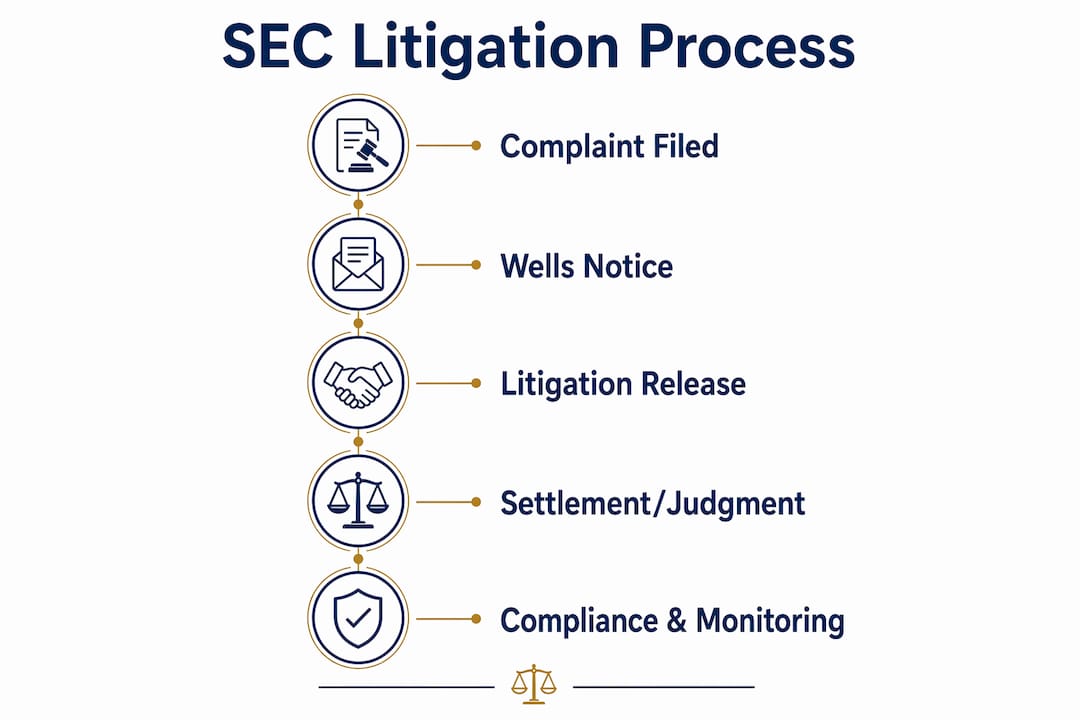
The SEC litigation process follows a defined sequence:
- Confidential investigation: The SEC Division of Enforcement opens a formal order of investigation. Subpoenas are issued, documents are reviewed, and witnesses are interviewed. None of this is public.
- Wells Notice issued: Before recommending an enforcement action, SEC staff sends a Wells Notice to the subject. This is a confidential communication stating that staff intends to recommend charges. It is the last opportunity for defense counsel to submit a Wells Submission arguing against the action.
- Commission authorization: SEC staff presents its recommendation to the full Commission. Commissioners vote on whether to authorize the filing of a civil complaint in federal court.
- Federal court filing: Once authorized, the SEC files the complaint in federal district court. This is the formal, public commencement of the civil action.
- Litigation Release issued: Simultaneously with or shortly after the court filing, the SEC publishes the Litigation Release on its website, notifying the public of the action.
“Effective legal intervention typically occurs during the confidential Wells Notice stage, which precedes the public Litigation Release.” — SEC Enforcement Manual
The Wells Notice stage is where experienced defense counsel can make the greatest difference. By the time a Litigation Release appears, the Commission has already voted to proceed. That is why waiting until a release is published to engage legal counsel is a costly mistake.
Recent Supreme Court decisions have also reshaped the SEC litigation process. In SEC v. Jarkesy, the Supreme Court ruled that defendants in civil penalty cases have a Seventh Amendment right to a jury trial in federal court. This ruling in SEC v. Jarkesy effectively requires the SEC to seek civil money penalties in federal court rather than in administrative proceedings, which means more cases will now result in federal court filings and corresponding Litigation Releases.

What are the practical implications for businesses and individuals?
A Litigation Release carries consequences that extend well beyond the named defendants. Businesses and individuals need to understand these downstream effects before they assume a release is someone else’s problem.
Reputational damage is immediate. The SEC publishes releases on its public website, and financial news outlets routinely pick them up within hours. Being named in a release, even as a relief defendant rather than a primary defendant, can damage investor confidence and business relationships before any court has made a final determination.
Automatic disqualifications can trigger without warning. Certain SEC enforcement actions, particularly those resulting in injunctions or consent decrees, automatically disqualify individuals and entities from specific activities. These include acting as an officer or director of a public company, relying on certain exemptions under Regulation D for securities offerings, or operating as a registered investment advisor. Monitoring SEC releases is therefore a compliance obligation, not just a best practice.
Sanctions disclosed in releases are serious. After a Litigation Release, enforcement actions may include disgorgement, civil monetary penalties, injunctive relief, and professional bars against individuals. Disgorgement requires defendants to return all ill-gotten gains. Civil penalties can reach millions of dollars per violation. Professional bars can end careers in the securities industry permanently.
Consent decrees require active compliance management. When a release announces a settlement or consent judgment, the named party has agreed to specific ongoing obligations. Violating those obligations can result in contempt proceedings and additional sanctions.
Pro Tip: If your business operates in financial services, set up a weekly review of the SEC’s Litigation Releases page filtered by your industry sector. A release naming a counterparty, vendor, or affiliated entity can trigger your own compliance obligations under anti-money laundering or know-your-customer rules.
How to access and use SEC litigation releases for due diligence
Locating and interpreting SEC Litigation Releases is a straightforward process once you know where to look and what to prioritize.
- Go directly to the SEC’s official releases page. The SEC maintains a searchable database at sec.gov under the Enforcement section. Releases are listed in reverse chronological order and are searchable by keyword, date range, and defendant name.
- Use the LR number system for precise tracking. Each release carries a unique LR number. If you are tracking a specific matter over time, note the LR number from the initial complaint release. Subsequent releases in the same matter will reference the same parties and often cite earlier LR numbers.
- Download and read the underlying legal documents. The release summary is written for public consumption. The actual complaint or judgment PDF contains the specific legal claims, factual allegations, and relief sought. For due diligence purposes, the underlying document is the authoritative source.
- Use third-party tracking tools for volume monitoring. Platforms like the SEC Litigation Releases API by Apify allow compliance teams to programmatically pull and filter releases. This is useful for financial institutions that need to screen counterparties against enforcement records at scale.
- Incorporate releases into your compliance workflow. Assign a compliance team member to review new releases weekly. Cross-reference named parties against your client, vendor, and counterparty lists. Document your review process to demonstrate regulatory diligence.
The comparison below shows the difference between passive and active monitoring approaches:
| Monitoring Approach | Method | Best For |
|---|---|---|
| Passive | Manual SEC website checks | Small businesses, individual investors |
| Active | API integration, automated alerts | Financial institutions, compliance teams |
| Reactive | Review only when a matter arises | High-risk, inadequate for regulated entities |
Understanding SEC crypto regulations alongside Litigation Releases gives businesses a fuller picture of their regulatory exposure, particularly in digital asset markets where enforcement activity has accelerated sharply.
Key takeaways
An SEC Litigation Release is the formal public record of civil enforcement, and engaging qualified legal counsel before the release is issued is the single most consequential decision a subject of SEC investigation can make.
| Point | Details |
|---|---|
| Definition of a release | An SEC Litigation Release is the official public announcement of a civil enforcement action filed in federal court. |
| LR number system | Each release carries a unique identifier (e.g., LR-26557) dating back to 1995, forming the primary public record of SEC civil litigation. |
| Wells Notice is the critical window | The Wells Notice stage, before any public release, is when legal intervention has the greatest impact on case outcomes. |
| Automatic consequences apply | Releases announcing injunctions or consent decrees can trigger automatic disqualifications from securities industry activities. |
| Active monitoring is a compliance duty | Businesses in regulated industries must track releases systematically to identify collateral compliance obligations. |
Why the wells notice stage is where the real battle is fought
Most people who contact a law firm about an SEC matter do so after they have already seen their name in a Litigation Release. By that point, the Commission has voted, the complaint is filed, and the public record exists. The strategic options narrow considerably once that happens.
The Wells Notice stage is where experienced counsel can genuinely change outcomes. A well-constructed Wells Submission can persuade SEC staff to narrow the scope of charges, reduce the number of defendants, or in some cases, decline to recommend any action at all. That opportunity disappears the moment the release goes live.
A common misconception is that a Litigation Release means a defendant has been found guilty of something. It does not. A release announcing a complaint means the SEC has filed allegations in court. The defendant retains the right to contest every claim. The problem is that the reputational damage from the public announcement often precedes any judicial determination by years.
For crypto businesses in particular, the SEC’s enforcement posture has shifted significantly since 2023. Releases involving digital asset issuers, exchanges, and lending platforms have multiplied. If your business operates in this space, treating SEC Litigation Releases as background noise is not a defensible compliance position.
The practical advice is direct: if you receive a Wells Notice, retain counsel with actual SEC enforcement experience immediately. If you see a Litigation Release naming a party connected to your business, have counsel assess your exposure before your next compliance cycle.
— Mark
How Murphyslawcrypto can help you navigate SEC enforcement
If you are facing an SEC investigation, have received a Wells Notice, or have seen your name or a counterparty’s name appear in a Litigation Release, the time to act is now.
Murphyslawcrypto is a licensed crypto law firm with direct experience in SEC enforcement matters, including cases involving Celsius, Terraform Labs, and BitMEX. The firm provides crypto fraud recovery litigation, regulatory defense, and compliance consulting for businesses operating in digital asset markets. Whether you need to respond to an active enforcement action or build a compliance program that anticipates SEC scrutiny, Murphyslawcrypto has the courtroom experience to protect your interests. Review your legal options for crypto fraud recovery and contact the firm before the next release changes your situation.
FAQ
What is a litigation release from the SEC?
An SEC Litigation Release is an official public announcement issued by the Commission regarding civil enforcement actions filed in federal court, covering complaints, settlements, consent judgments, and final judgments. It serves as the primary public record of the SEC’s civil litigation activity.
When does the SEC issue a litigation release?
The SEC issues a Litigation Release at or shortly after the moment it files a civil complaint in federal district court. The release is not issued during the confidential investigation or Wells Notice stages that precede it.
Does a litigation release mean someone has been found guilty?
No. A release announcing a complaint means the SEC has filed allegations in court. The defendant has the right to contest all claims. Only a consent judgment or final judgment release reflects an agreed or court-ordered resolution.
How do i find SEC litigation releases for a specific company or individual?
The SEC’s official website at sec.gov maintains a searchable Litigation Releases database. You can search by defendant name, date range, or keyword. Each release also carries a unique LR number for precise tracking across related filings.
What should a business do after spotting a relevant litigation release?
A business should immediately review the underlying complaint or judgment PDF, cross-reference the named parties against its own counterparty and vendor lists, and consult qualified legal counsel to assess any collateral compliance obligations triggered by the release.
Recommended
- SEC Crypto Regulations Explained: What You Need to Know – Murphy’s Law – Crypto Law Firm
- Crypto Fraud Recovery Litigation – Murphy’s Law – Crypto Law Firm
- Law.com: Investors Accuse Alston & Bird of Enabling $328M Crypto Ponzi Scheme – Murphy’s Law – Crypto Law Firm
- Law360: Investors Accuse Alston & Bird of Aiding $328M Crypto Fraud – Murphy’s Law – Crypto Law Firm